
The complete UK guide to longcase clocks
Grandfather Clock
A grandfather clock is a tall, freestanding clock that uses weights and a swinging pendulum to keep time. It is known for its beautiful wooden case, classic design, and gentle ticking sound. Many people choose a grandfather clock to add a timeless look to their home.
Whether you are looking for an antique grandfather clock, a modern design, or help with grandfather clock repair, this guide will help you understand what to look for. You will learn how these clocks work, how to care for them, and how to choose the right one for your home.
From clock history and parts to buying advice and common repairs, this guide covers the most important things every grandfather clock owner should know.
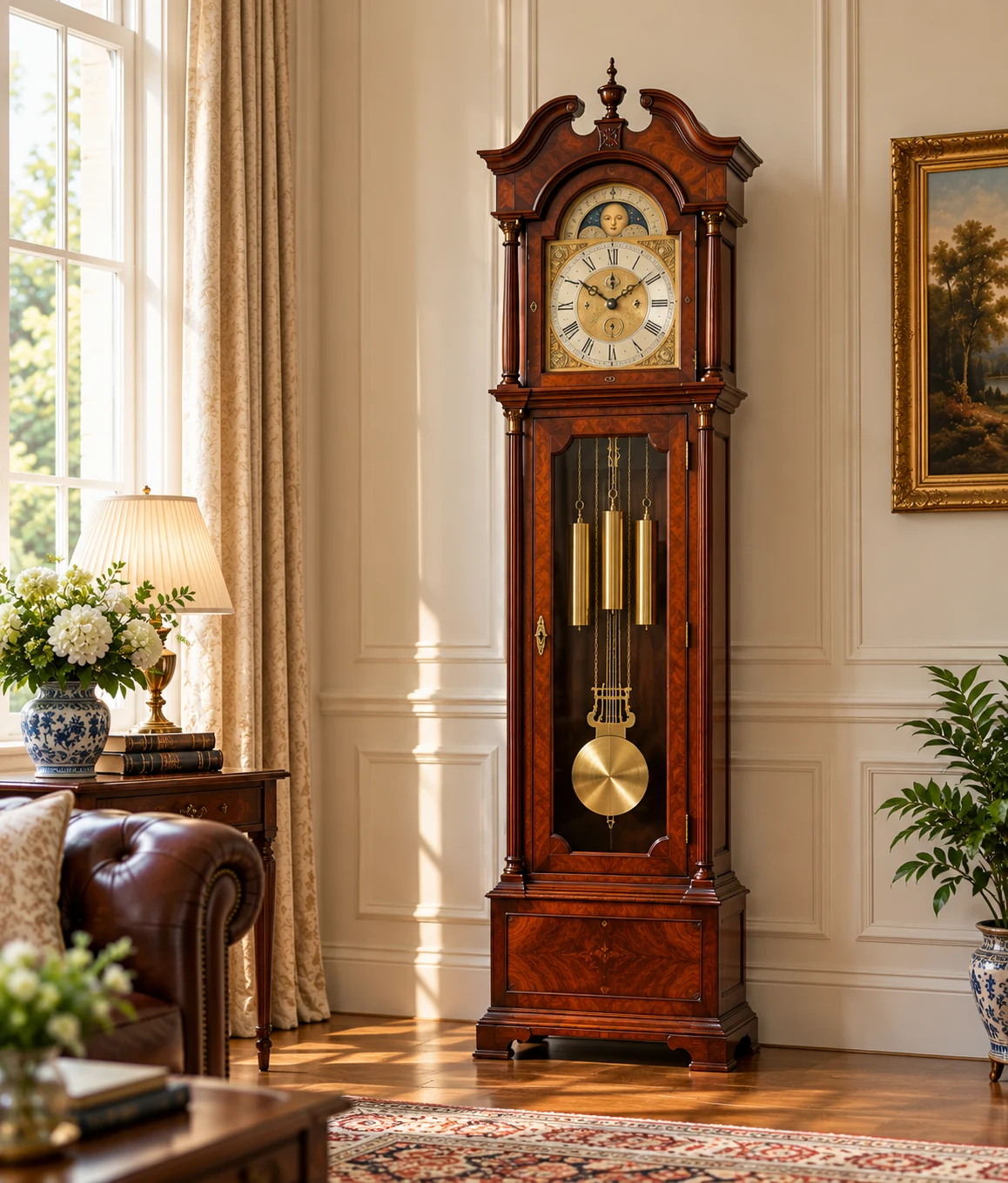
Grandfather Clock
A classic floor-standing timepiece
In short
Key takeaways
- A grandfather clock is also called a longcase clock or tall-case clock.
- Most traditional clocks use hanging grandfather clock weights to power the movement.
- The pendulum controls how fast the clock runs.
- Many mechanical grandfather clocks need winding once a week.
- An antique grandfather clock may have historical and decorative value, but its condition matters.
- Brands such as Howard Miller, Ridgeway, Emperor, and Seth Thomas are known in the grandfather clock market.
- Regular care can help a clock run for many years.
- If your clock stops, runs incorrectly, or has a chime problem, it may need professional grandfather clock repair.
- Before buying a clock, check its movement, dial, case, condition, and service history.
- Always take proper care when moving a grandfather clock because its pendulum, weights, and movement can be damaged.
The facts
At a glance
| Other names | Longcase clock, tall-case clock, floor clock, hall clock |
| Power | Hanging weights or batteries in quartz models |
| Timekeeper | Pendulum in traditional mechanical clocks |
| Running time | 30-hour or 8-day |
| Typical height | Around 6 to 8 feet, depending on the model |
| Main Material | Oak, mahogany, walnut, cherry, and other woods |
| Main Parts | Hood, dial, movement, pendulum, weights, trunk, and base |
| Popular Chime | Westminster Quarters |
| Common Styles | Traditional, antique, vintage, modern, and contemporary |
| Common Brands | Howard Miller, Ridgeway, Emperor, Seth Thomas, and Sligh |
The basics
What is a grandfather clock, and what else is it called?
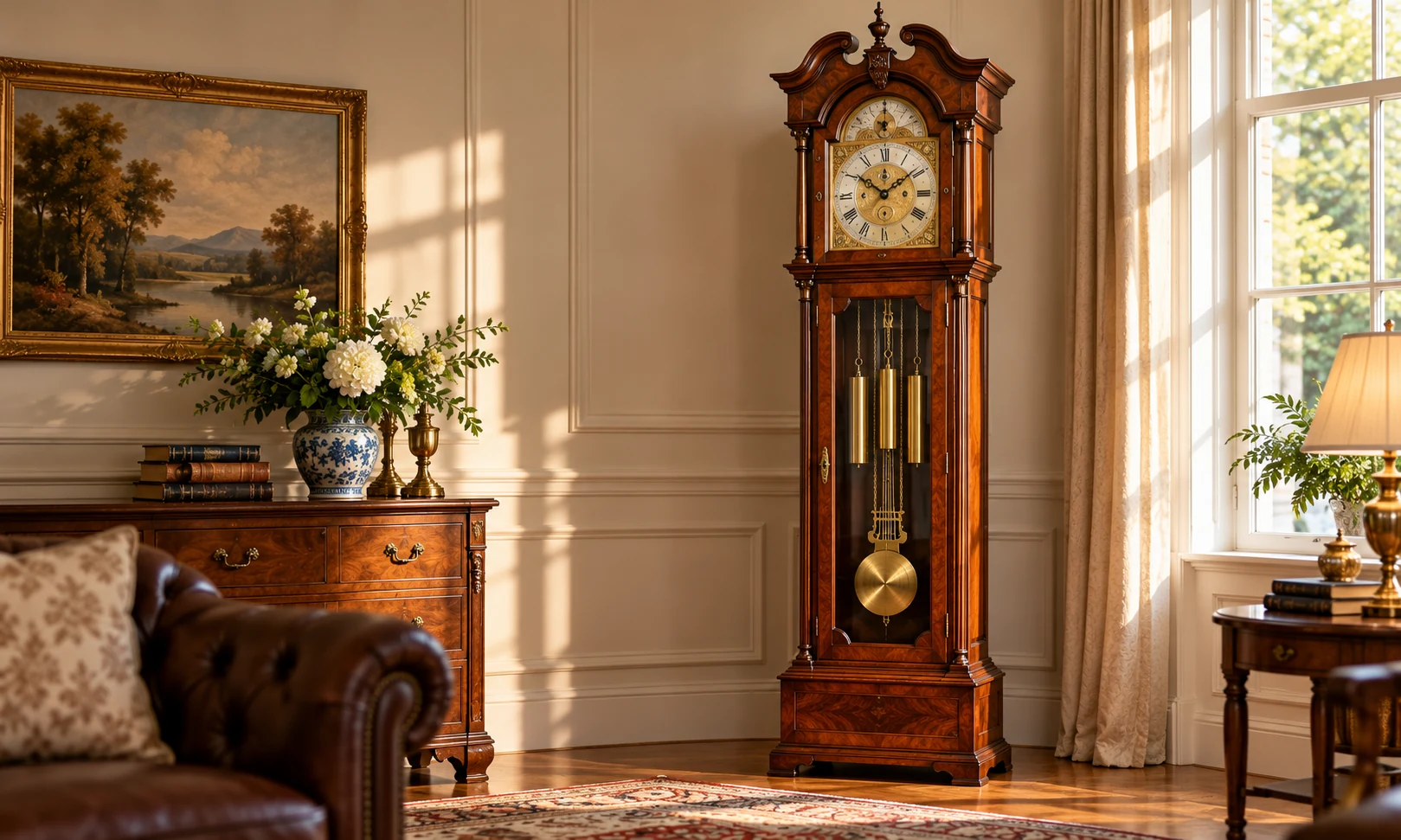
A grandfather clock is a tall clock that stands on the floor. It usually has a wooden case, a clock face, a pendulum, and hanging weights. The weights provide power, while the pendulum helps the clock keep time.
You may also hear it called a longcase clock, tall-case clock, floor clock, or hall clock. These names are often used for the same type of clock.
The tall case is not just for looks. It gives the pendulum enough room to swing and allows the weights to move down slowly as they power the clock.
The Three Main Parts
The hood
The hood is the top part of the clock. It holds the dial and the clock movement. Some hoods have glass panels, decorative columns, or a curved top
The trunk
The trunk is the long middle section of the case. It usually has a door and contains the pendulum and weights.
The base
The base is the bottom part of the clock. It supports the case and helps the clock stand firmly on the floor.
Know the family
Types and Sizes of Grandfather Clocks
Grandfather clocks used to be in many styles. Some are made to look traditional, while others have a simple and modern design. The size, shape, materials, and movement can all be different.
Traditional grandfather clock
Traditional clocks often have a wooden case, a decorative hood, and a classic clock face. They may include carved details, brass parts, and chime features.
Modern Grandfather Clock
A modern grandfather clock usually has clean lines and a simple design. Some models use glass panels, lighter wood colors, or metal details. They can fit well in modern homes.
Mission Style Grandfather Clock
Mission-style clocks have straight lines and a simple shape. Oak is a common material. These clocks focus more on clean design than heavy decoration.
Mechanical Grandfather Clock
A mechanical grandfather clock uses weights, gears, and a pendulum. It needs winding and may play chimes. Many clock lovers prefer this type because of its traditional movement and sound.
Quartz Grandfather Clock
A quartz clock usually runs on batteries. It does not need regular winding and is often easier to maintain. However, it does not offer the same traditional mechanical movement.
Grandmother and Granddaughter Clocks
Grandmother clocks are generally shorter and slimmer than grandfather clocks. Granddaughter clocks are usually even smaller. Sellers may use different height ranges, so always check the actual measurements.
Tabletop Grandfather-Style Clock
These are small clocks designed to look like grandfather clocks. They sit on a table, shelf, or desk. They are not full-size longcase clocks.
Grandfather Wall Clock
A pendulum clock that hangs on the wall, such as a Vienna regulator
Good to know
Vintage, Old, or Antique?
The words vintage, old, and antique are often used when describing clocks. However, they do not always mean the same thing.
Antique grandfather clock
An antique is commonly described as an item that is at least 100 years old.
Vintage grandfather clock
Vintage is a more flexible term. It is often used for clocks that are older but may not be 100 years old yet.
Old grandfather clock
This is a general term. It does not tell you the clock’s exact age or value.
Period names
You may also see period names such as Georgian, Victorian, and Edwardian in clock listings. These names can help you understand the time period in which a clock was made.
Georgian
Victorian
Edwardian
Before you buy
Measure first
Many new grandfather clocks are around 7 feet tall or more. Antique clocks can have different heights, so measure your room, doorways, and stairs before buying one.
A short history
Who invented the grandfather clock, and when was the first one made?
The grandfather clock was not invented by one person alone. Its development came from improvements in pendulum clocks and clockmaking.
Christiaan Huygens built the first practical pendulum clock in the Netherlands in 1656. Later, English clockmakers developed the tall case that became the familiar longcase clock.
The early English clockmakers helped make these clocks more accurate and useful for homes and public buildings.
1656 — First Practical Pendulum Clock
Christiaan Huygens built a practical pendulum clock in the Netherlands.
Following Years — Pendulum Clocks Reach England
The Fromanteel family helped introduce pendulum clockmaking to England.
Around 1670 — The Longcase Design Develops
English clockmakers began using the anchor escapement, which made it possible to use a longer pendulum.
1671 — William Clement
William Clement made an anchor-escapement turret clock for King’s College, Cambridge.
Late 1600s — Thomas Tompion
Thomas Tompion became one of the most respected English clockmakers. His clocks are still known among collectors
1793 — Westminster Quarters
The tune later known as Westminster Quarters was written for Great St Mary’s, Cambridge.
1876 — “My Grandfather's Clock”
The song “My Grandfather’s Clock” helped popularize the name grandfather clock.
Who invented the anchor escapement?
The history of the anchor escapement is still debated. Several clockmakers and inventors have been connected with its development.
Two of the best-known English makers
Thomas TompionThomas Tompion was a leading English clockmaker. His work is known for quality, precision, and careful craftsmanship.
1639 – 1713
Joseph KnibbJoseph Knibb was another important English clockmaker. His clocks are highly valued by collectors.
1640 – 1711
Netherlands
The pendulum clock began
→
England
The tall case was developed
So where did the grandfather clock originate? The pendulum clock began in the Netherlands. The tall wooden case developed in England during the late 1600s.
This is why the traditional longcase clock is strongly connected with English clockmaking history.
Inside the case
How does a grandfather clock work?
This is why the traditional longcase clock is strongly connected with English clockmaking history.
A mechanical grandfather clock works through a system of weights, gears, a pendulum, and an escapement. The weights provide power, the gears move the hands, and the pendulum controls the timing.
01
Winding
Winding raises the weights. This stores energy that the clock will use while running.
02
Gravity
As the weights slowly move down, gravity provides power to the clock’s gears.
03
The escapement
The escapement controls how the gear movement is released. It allows the gears to move in small steps with each swing of the pendulum.
04
The pendulum
The pendulum swings back and forth at a steady pace. Its length helps control how fast the clock runs.
05
Separate trains
Many clocks have separate gear trains for different functions. The going train moves the clock hands, the strike train sounds the hours, and the chime train plays the musical tune.
Anatomy
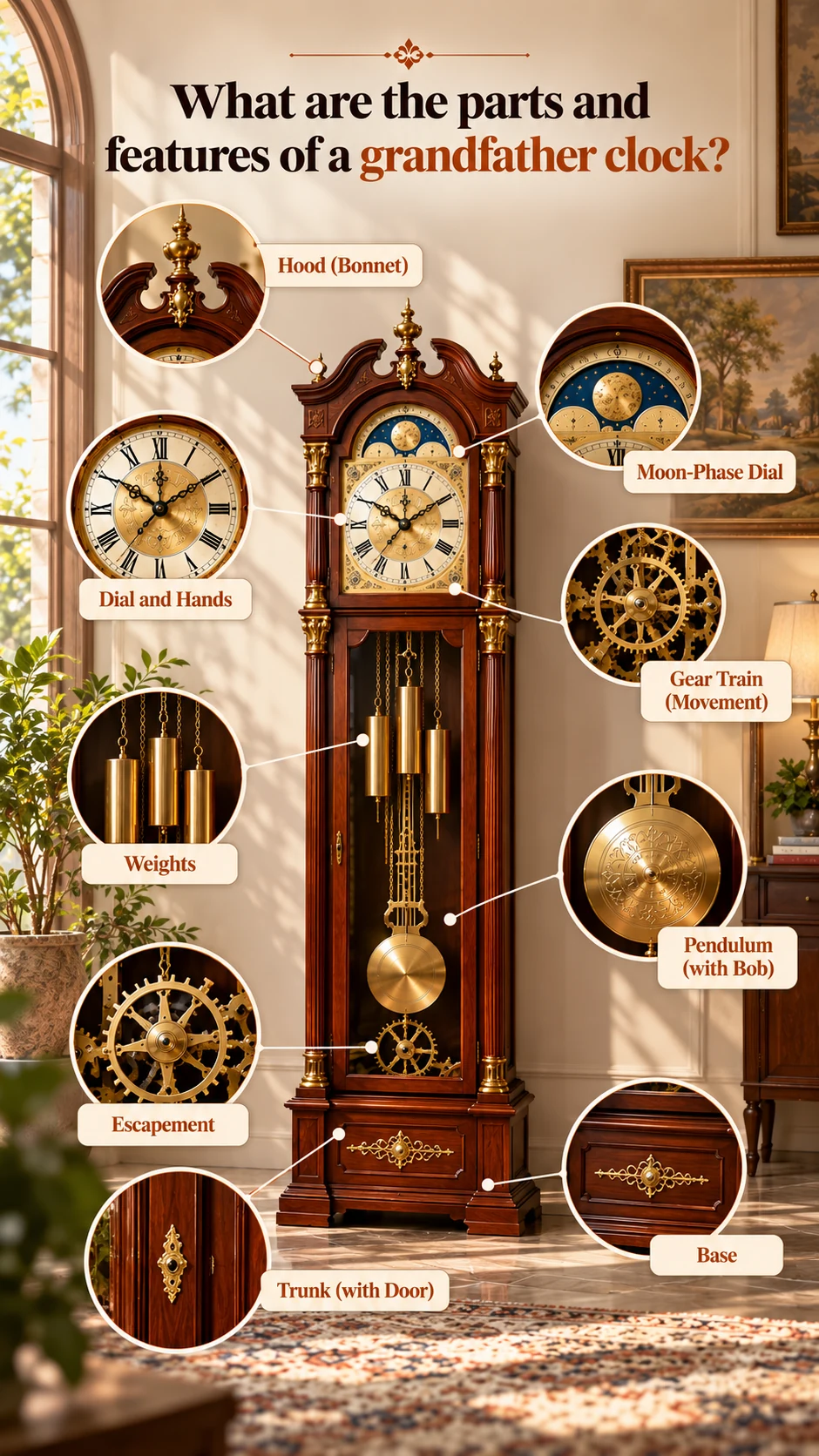
What are the parts and features of a grandfather clock?
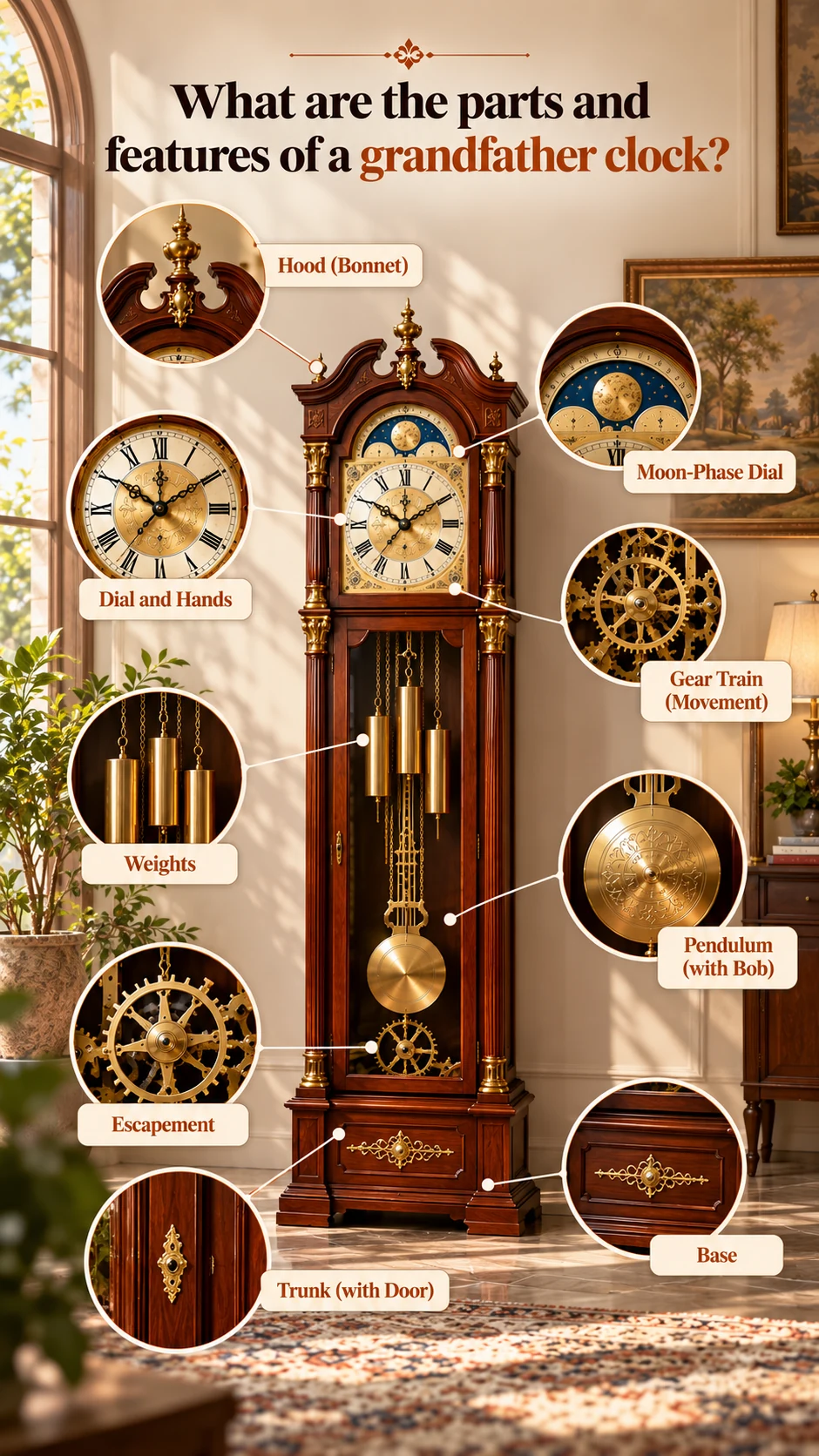
A grandfather clock has several important parts. Each part has a different job, from keeping time to supporting the clock’s movement.
Clock Parts Diagram Labels
01
HoodHolds the dial and movement
02
Dial and handsDial and HandsShow the time. Some dials also include a seconds ring, date, or moon phase.
03
MovementThe gears and mechanical parts behind the dial.
04
EscapementControls the release of power from the movement.
05
Pendulum, Bob, and Rating NutThe pendulum controls the timing. The bob and rating nut help adjust its speed.
06
WeightsProvide power to the clock.
07
Trunk and DoorHouse the pendulum and weights.
08
BaseSupports the clock and helps it stand firmly
Common features
★ Chime: Plays a tune at set times.
★ Moon-phase dial: Shows the moon's phase.
★ Seconds ring: Displays seconds
★ Night-time silence: Allows the chime to be turned off during certain hours.
How Does a Grandfather Clock Keep Time?
The pendulum swings at a regular pace. The escapement connects the pendulum to the clock’s gears. Together, these parts help the hands move at the correct speed.
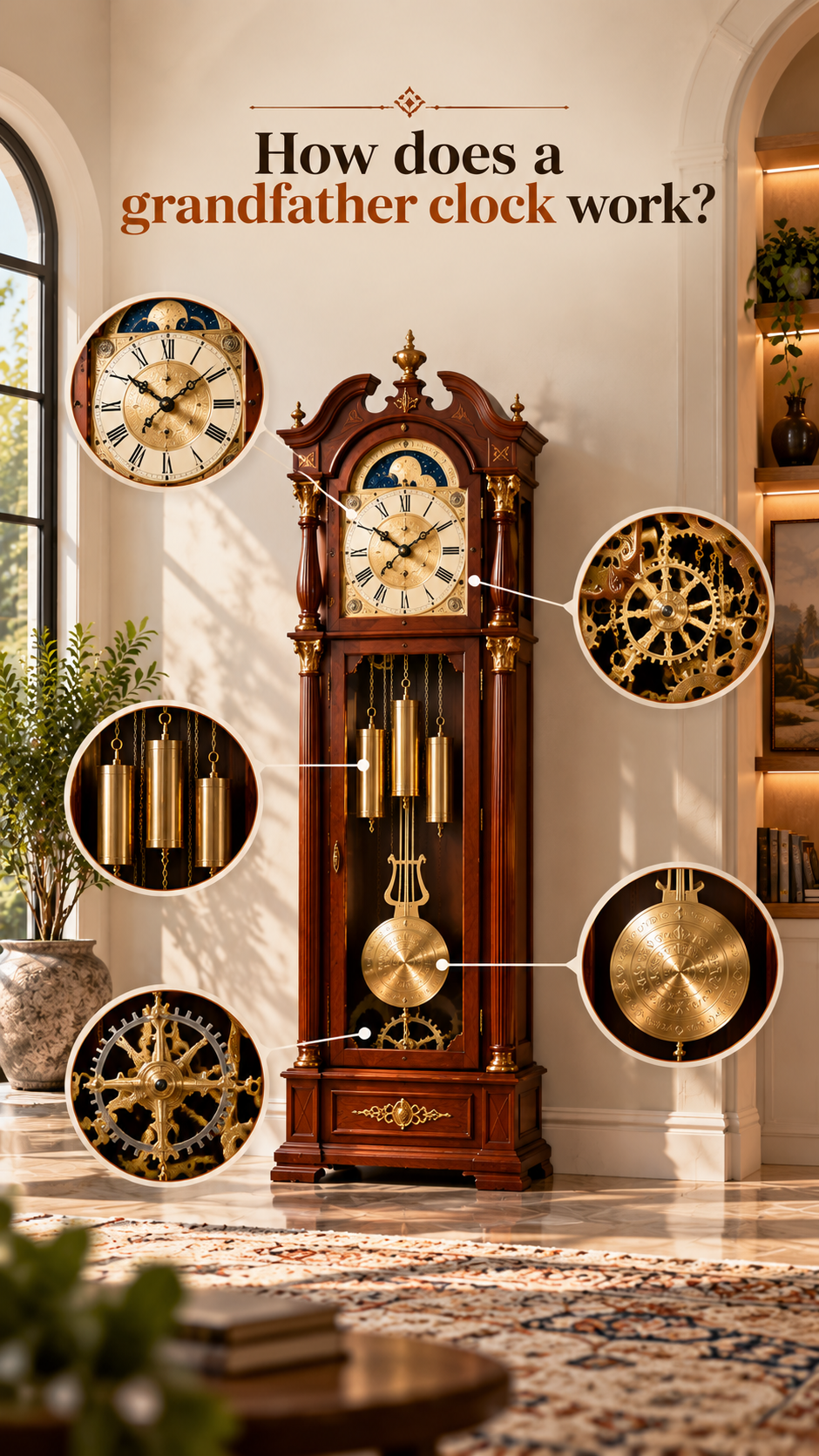 Inside the clock
Escapement — Verge vs. Anchor
Why Did the Grandfather Clock Case Become Tall?
Early clocks used a verge escapement. It required a wider pendulum swing, so the pendulum had to be shorter.
The anchor escapement allowed a smaller swing. This made it possible to use a longer pendulum, which improved timekeeping and helped create the tall longcase design.
Verge escapement
- Requires a wide swing.
- Works with a shorter pendulum.
- Found in some early clock designs
Anchor escapement
- Uses a smaller swing.
- Allows a longer pendulum.
- Helped make tall grandfather clocks possible.
Speed adjustment
The rating nut
Many mechanical grandfather clocks have a rating nut under the pendulum bob.
Raise the bob to make the clock run faster.
Lower the bob to make the clock run slower
Make small changes and check the clock over several days. The exact adjustment can depend on the clock’s movement.
Temperature can also affect timekeeping. A warmer room may slightly lengthen a pendulum rod and make the clock run slower.
| Part | Job |
|---|---|
| Hood | Holds the dial and movement |
| Dial and hands | Display the time |
| Movement | Contains the gears and clock mechanism |
| Escapement | Controls the movement of the gears |
| Pendulum and bob | Help keep the clock’s timing steady |
| Rating nut | Adjusts the clock’s speed |
| Weights | Provide power |
| Trunk and door | Hold the pendulum and weights |
| Base | Supports the clock |
30-hour
A 30-hour clock usually needs winding every day. These clocks are often found in older or simpler designs.
MOST BETTER CLOCKS
8-day
An 8-day clock can run for about one week after winding. This is a common type of mechanical grandfather clock.
Month-going
A month-going clock can run for about a month after winding. These clocks are less common and may be more specialized.
Movements
Who makes the movements?
The movement is the working mechanism inside the clock. It controls the hands, chimes, and other features.
Some modern grandfather clocks use German movements. Hermle and Kieninger are well-known names in clock movement manufacturing. Howard Miller is a major American clock brand and uses different movement suppliers across its models.
When buying a new clock, ask:
- Who made the movement?
- Is the movement mechanical or quartz?
- Are replacement parts available?
- Can a clock repair specialist service it?
- Does the clock have a warranty?
Tip: when buying new, ask which movement it has and who supplies parts in the UK.
Brand spotlight
Howard Miller Grandfather Clocks
A Howard Miller grandfather clock is a popular choice for people looking for traditional or modern clock designs. Models may include different wood finishes, chimes, and movement features.
Models may include
Different wood finishes
Chimes
Movement features
Buying checklist
Check before buying
If you are looking for a Howard Miller grandfather clock for sale, check the model number, movement type, condition, warranty, and parts support before buying.
Model number
Movement type
Condition
Warranty
Parts support
The face of the clock
Dials and numbers: Roman numerals, moon phase and complications
The dial is the part of the clock that displays the time. Grandfather clock dials can be simple or highly decorative.
Moon-Phase Dial: A moon-phase dial shows the changing phases of the moon. Some clocks have a rotating moon disc above the main dial.
If a moon-phase disc stops working, check the clock’s manual before trying to reset it. Never force the disc because its mechanism may be delicate.
- Seconds ring
- Date display
- Moon-phase disc
- Decorative artwork
- Moving figures or automata
Sound
Grandfather clock chimes
Many mechanical grandfather clocks play a melody before striking the hour. The sound is one of the features people enjoy most about these clocks.
Westminster Quarters
Westminster Quarters is one of the most familiar grandfather clock melodies. It is often associated with clocks that play a tune every quarter hour.
Whittington
Whittington is another chime melody found on some triple-chime movements.
St Michael
St. Michael is also available on certain triple-chime clocks. The available tunes depend on the movement installed in the clock.
Chimes
What Is a Triple-Chime Grandfather Clock?
A triple-chime clock usually offers three melodies, often Westminster, Whittington, and St. Michael.
Melody 1
Westminster
Melody 2
Whittington
Melody 3
St. Michael
Chime selector
A chime selector allows the owner to choose the tune.
Check before buying
Not every clock has all three melodies. Check the movement and product details before buying.
Settings
Night setting and volume
Some grandfather clocks include a night setting that silences the chimes during certain hours. This can be useful if the clock is placed in a bedroom or living area.
The silence period depends on the movement and model. Check the clock’s manual to learn how its night setting works.
Can You Adjust the Volume?
Some clocks allow the chime to be turned off, but the volume may not be adjustable. On many clocks with chime rods, the sound level is set by the movement and case.
Do not move the chime selector while the clock is actively chiming unless the manual says it is safe.
Fun fact
Grandfather clock and metronome
A grandfather clock and a metronome both use a swinging pendulum or similar timing system to create a steady beat.
A grandfather clock measures time. A metronome helps musicians keep a steady rhythm while playing music.
Both show how a regular movement can be used to measure time or rhythm.
Craftsmanship
Grandfather Clock Cases and Woods
The wooden case is one of the most noticeable parts of a grandfather clock. The wood, finish, carving, and shape can change the clock’s appearance and value.
Veneer over oak
Mahogany
Mahogany is known for its rich color and smooth appearance. Many clocks use mahogany veneer over a wooden structure.
Usually solid
Oak
Oak is strong and has a visible grain. It is often used in traditional and Mission-style grandfather clocks.
Marquetry
Walnut
Walnut has a warm, dark appearance. It is found in many traditional and antique clock cases.
Lacquered
Japanned / chinoiserie
Some antique clocks have painted or lacquered cases with decorative designs. These finishes can be highly detailed.
Look closely
Later carving
Some clock cases have carved decorations added at a later time. When buying an antique, check whether the case details are original.
New Grandfather Clocks
New clocks may use oak, cherry, walnut, mahogany, or other materials. They are available in traditional and modern styles.
Oak
Cherry
Walnut
Mahogany
The best choice depends on your home, personal style, budget, and the type of finish you prefer.
Budget
How Much Does a Grandfather Clock Cost?
The price of a grandfather clock can vary widely. A simple clock may cost much less than a rare antique or a high-end mechanical model.
The price usually depends on the clock’s age, maker, materials, movement, condition, and features.
£295 – £12,950
Asking prices seen on a UK dealer platform in October 2026
What Affects the Price?
- The Maker: A well-known clockmaker or brand may increase the clock's value.
- Movement Type: Mechanical movements can cost more than simple quartz movements.
- Case and Wood: The quality, finish, and type of wood can affect the price.
- Dial and Features: Moon-phase dials, special chimes, and decorative details may add value.
- Rare features such as moon phase
- Condition and Originality: A clock with original parts and a well-maintained movement may be more desirable than one with many replacements.
Example Price Guide
Prices can change based on the model, seller, location, and condition.
| Clock Type | Price Factors |
|---|---|
| Basic quartz grandfather-style clock | Usually more affordable |
| New mechanical grandfather clock | Movement, case, and brand |
| Vintage grandfather clock | Age, condition, and originality |
| Antique grandfather clock | Maker, rarity, condition, and history |
| Rare collector clock | Maker, provenance, and specialist demand |
What Makes a Grandfather Clock Valuable?
- Famous maker
- Original movement and dial
- Good case condition
- Rare design
- Historical importance
- Complete parts
- Documented service history
An old clock is not automatically valuable. Its condition, originality, and maker are important.
Decide
New or Antique, Mechanical or Quartz?
Choosing a grandfather clock depends on what you want from it. Some people want a clock with history, while others prefer a new clock that is easier to maintain.
Antique Grandfather Clock
Choose for
Character, history, and traditional craftsmanship.
Appearance:
Unique and historic
Winding
Often daily or weekly
Servicing
May need a specialist
Main concern:
Hidden repairs or missing original parts
Value:
Depends on condition and maker
New mechanicalNew Mechanical Grandfather Clock
Choose for
Traditional sound and a new clock with available support.
Appearance:
Traditional or modern
Winding
Often weekly
Servicing
Depends on the movement and manufacturer
Main concern
Long-term parts availability
Investment
Not guaranteed as an investment
Quartz Grandfather Clock
Choose for
Simple operation and less winding.
Appearance:
Different styles available
Winding
No manual winding
Servicing
Usually simpler
Main concern
Does not offer the same mechanical movement
Investment
Usually purchased for use rather than collecting
Checklist
Checklist for Buying a New Clock
1
Movement make and type
2
Cable or chain drive
3
Chime melodies
4
Night shut-off feature
5
Solid wood or veneer
6
Warranty length
7
Delivery and set-up
8
Service and parts availability
Buying tip
What Is a “Marriage” in a Grandfather Clock?
A clock is sometimes called a “marriage” when its case, dial, or movement comes from different clocks.
Case
may come from a different clock
Dial
may come from a different clock
Movement
may come from a different clock
Hard to spot
This is not always easy to notice.
Ask the seller
Ask the seller which parts are original and which parts have been repaired or replaced.
Buyer’s checklist
How to check an antique or used grandfather clock
Buying a used or antique grandfather clock can be exciting. However, you should check the clock carefully before paying for it.
Dial and movement
Check whether the dial and movement appear to belong together. Look for signs of replacement or unusual holes.
Case and movement
The style and age of the case should make sense for the movement and maker.
Base
Check the base for damage, repairs, or replacement parts.
Glass and hands
Look at the glass, hands, and pendulum. Replaced parts may affect the clock's originality.
Dial Connection
A repainted dial may look attractive, but it may not have the same collector value as an original dial.
Maker’s Marks
Look for the maker's name and numbers on the dial, movement, or case.
Woodworm and cracks
Check the wood for holes, cracks, damage, or signs of past treatment.
Running
If possible, see the clock running. Listen to the tick and check whether it strikes correctly.
Paperwork
Ask for a written description, service history, and any available valuation documents.
Buying in the UK
Where Can You Buy a Grandfather Clock?
You can buy a grandfather clock for sale through specialist clock shops, antique dealers, auction houses, online marketplaces, and private sellers.
Where to buy
A
Specialist antique dealers
Specialist dealers may offer antique clocks, restoration services, and delivery. Ask for details about the clock’s condition and originality.
B
Auctions
Auctions can offer a wide range of clocks. Review the condition report and buyer fees before bidding.
C
Specialist Clock Retailers
Retailers often sell new mechanical and quartz clocks. They may also provide warranties and setup services.
D
Private sales and marketplaces
Private listings may offer different prices and styles. Ask for clear photos, measurements, a written description, and information about repairs.
Checklist
Your Buying Checklist
Before purchasing:
1
Confirm the clock’s height and width.
2
Check that it will fit through your doors and stairs.
3
Ask about delivery and setup.
4
Confirm whether the movement works.
5
Ask about the warranty or return policy.
6
Check whether repair parts are available.
7
Read the seller’s description carefully.
Step by step
How to Set Up, Wind, and Regulate a Grandfather Clock
Setting up a grandfather clock correctly helps it run smoothly. Instructions can vary by model, so always follow the clock’s manual when available.
01
Check the label
Find the model and serial number. These details can help you locate the correct manual or replacement parts.
02
Unpack Carefully
Remove transport materials according to the manufacturer’s instructions. Do not pull or force delicate parts.
03
Level the Clock
Place the clock on a firm, level floor. Use the clock’s levelling feet if it has them.
04
Hang pendulum and weights
Attach the pendulum and weights to their correct positions. Follow the labels or manual because the weight positions can differ by movement.
05
Set the time
Use the instructions for your clock. Some clocks should only have their hands moved in a certain direction.
06
Start the pendulum
Gently move the pendulum to one side and release it. The clock should begin ticking.
07
Wind the Clock
Use the correct key or crank. Do not force the winding mechanism. If you feel unusual resistance, stop and check the manual.
08
Regulate the Clock
If the clock runs fast or slow, adjust the rating nut in small steps. Check the time over several days before making another adjustment.
Safety
Make sure the clock stands firmly and cannot tip over. A tall clock may need additional safety support, especially in homes with children or pets.
When the clocks change
When daylight saving time begins or ends, follow your clock's manual for changing the time. Some movements may not safely allow the hands to be moved backward.
Troubleshooting
Why Has My Grandfather Clock Stopped or Stopped Chiming?
A grandfather clock may stop for several reasons. It may need winding, leveling, or a simple adjustment. Some problems, however, require a clock repair specialist.
Usual causes
The clock has not been wound.
The clock is not level.
The pendulum is not correctly attached.
A weight or cable is out of position.
The movement needs servicing.
Packing material was left inside.
Problem 1
Clock stops
What to check first:
1
Is the clock wound?
2
Is the case level?
3
Is the pendulum attached correctly?
4
Are the weights and cables in their proper positions?
5
Is any packing material still inside?
2
Clock Runs Fast or Slow
What to check first
The pendulum may need a small adjustment. Use the rating nut only if you understand how it works. Make small changes and give the clock time to settle.
3
Clock Does Not Strike or Chime
What to check first
- Is the chime selector set to silent?
- Is the night shut-off active?
- Are the weights in the correct positions?
- Does the manual show a different setup?
4
Clock Strikes the Wrong Hour
The hour hand may not match the hour being struck. Some clocks allow a simple correction, but the correct method depends on the movement.
5
Chimes Are Not Correctly Timed
The minute hand or chime mechanism may need adjustment. On an antique clock, it is safer to ask a clockmaker.
Ask a clockmaker
6
Chime Sounds Wrong
The hammers may not be hitting the rods correctly. Do not bend parts unless the manufacturer’s instructions explain how to do it.
7
Moon Dial Is Stiff
Do not force the moon-phase disc. Its mechanism may be delicate and may need adjustment.
When to get help
Ask a Restorer
If the clock has damaged parts, unusual noises, or repeated problems, contact a qualified clock repair specialist.
Good news: A clock that has stopped is not always beyond repair. It may simply need cleaning, adjustment, or servicing.
Care
Grandfather Clock Servicing, Repair, and Finding a Restorer
Regular care helps a mechanical grandfather clock work properly. Dust, worn parts, and old oil can affect the movement over time.
Care
Grandfather Clock Servicing, Repair, and Finding a Restorer
Regular care helps a mechanical grandfather clock work properly. Dust, worn parts, and old oil can affect the movement over time.
What Happens During a Clock Service?
A professional movement overhaul may include:
- Taking apart the movement
- Cleaning the parts
- Checking pivots and worn areas
- Replacing damaged parts
- Reassembling the movement
- Applying the correct oil
- Testing the clock
Important
Do not oil it yourself
Do not apply oil to the movement yourself unless you have the proper knowledge. Too much or the wrong type of oil can cause problems.
When Should a Grandfather Clock Be Serviced?
The service interval depends on the clock, how often it runs, its environment, and its condition. A clock repair specialist can recommend a suitable schedule.
How to Find Grandfather Clock Repair Near Me
If you need grandfather clock repair near me, look for a clockmaker or repair specialist who has experience with longcase clocks.
Before choosing a repair service, ask:
- Do you repair mechanical grandfather clocks?
- Can you service this movement brand?
- Do you provide a written estimate?
- Are parts included in the estimate?
- Do you offer pickup, delivery, or in-home service?
- Is the repair covered by a guarantee?
Grandfather Clock Repairs
Professional grandfather clock repairs may include movement servicing, chime adjustment, pendulum repair, weight replacement, dial repair, or case restoration.
Movement servicing
Chime adjustment
Pendulum repair
Weight replacement
Dial repair
Case restoration
The type of repair depends on the problem. Compare written estimates and ask what work will be done.
Keep it safe
Protect Your Clock
Keep the clock away from direct sunlight, moisture, and sudden temperature changes. If it is valuable, keep its receipt, service records, and any valuation documents.
FAQ
Grandfather Clock FAQs
Quick answers to common questions about grandfather clocks.
What Is Another Name for a Grandfather Clock?
A grandfather clock is also called a longcase clock, tall-case clock, floor clock, or hall clock.
Who Invented the Grandfather Clock?
No single person invented the grandfather clock. The pendulum clock was developed by Christiaan Huygens, and English clockmakers later developed the tall longcase design.
When Was the First Grandfather Clock Made?
The longcase design began to develop in England around the late 1600s.
How Does a Grandfather Clock Work?
Weights provide power, gears move the hands, and a pendulum controls the clock’s timing.
How Often Do You Wind a Grandfather Clock?
Many mechanical grandfather clocks run for about 8 days after winding. Some clocks need daily winding, while others have different running times.
How Much Does a Grandfather Clock Cost?
The price depends on the clock’s brand, age, movement, materials, condition, and features. Antique and rare clocks may cost more than basic models.
Where Can I Buy a Grandfather Clock?
You can buy one from specialist clock retailers, antique dealers, auctions, online marketplaces, or private sellers.
Is a Grandfather Clock a Good Investment?
Some rare clocks may be valuable to collectors, but value is not guaranteed. A clock’s maker, condition, originality, and demand all matter.
Can I Move a Grandfather Clock Myself?
Moving a grandfather clock can be difficult and risky. The pendulum, weights, and movement need careful handling. Read the full guide on how to move a grandfather clock before moving one.
What Is the Difference Between a Grandfather Clock and a Longcase Clock?
The terms are commonly used for the same type of tall, floor-standing clock.
What Is a Tempus Fugit Grandfather Clock?
“Tempus Fugit” is Latin for “time flies.” The phrase often appears on grandfather clock dials. It is not necessarily the name of the clock’s maker.
What Is a Howard Miller Grandfather Clock?
Howard Miller is a well-known clock brand that makes different styles of grandfather clocks, including traditional and contemporary models.
What Is a Ridgeway Grandfather Clock?
Ridgeway is a grandfather clock brand known for traditional and decorative clock designs. Check the model and movement details when buying one.
What Is an Emperor Grandfather Clock?
Emperor is a name found on grandfather clocks and clock kits. The model, movement, and condition help determine what a particular clock is worth.
What Is a Seth Thomas Grandfather Clock?
Seth Thomas is a historic American clockmaking name. Older clocks bearing the name may be of interest to collectors, depending on their condition and originality.
What Is a Sligh Grandfather Clock?
Sligh is a furniture and clock brand associated with traditional and decorative designs. Check the model details and movement when buying a Sligh clock.
Can You Find a Grandfather Clock for Sale?
Yes. Grandfather clocks are available through clock retailers, antique shops, auctions, and online marketplaces. Always check the condition and delivery details.
What Is Grandfather Clock Symbolism?
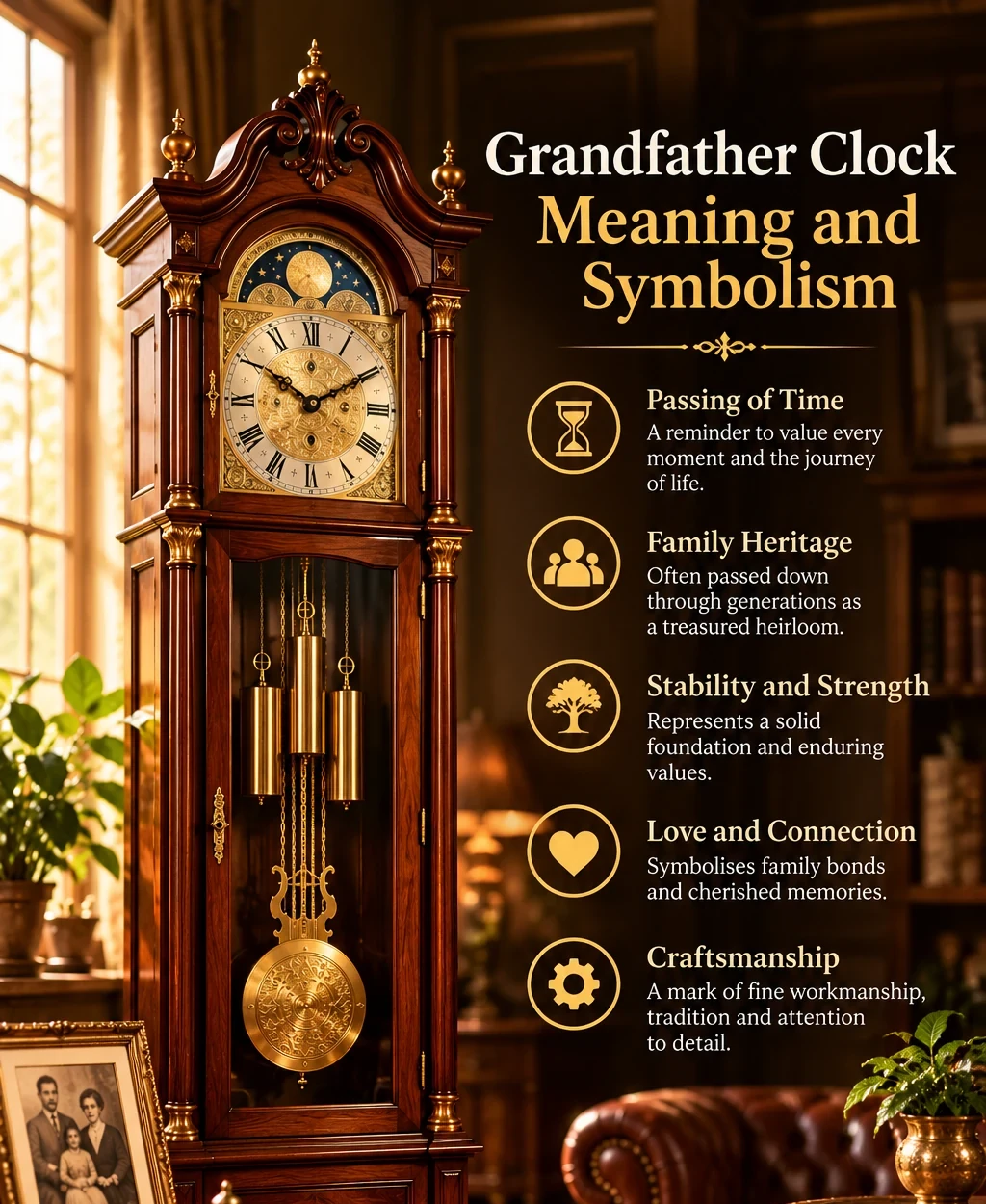
A grandfather clock is often seen as a symbol of time, family history, tradition, and memories. Its meaning can vary from person to person.
Are There Grandfather Clocks in Minecraft?
Minecraft players may use decorative clock builds that look like grandfather clocks. These are creative builds rather than real mechanical clocks.
What Does “Grandfather Grandfather Clock” Mean?
The phrase “grandfather grandfather clock” is usually a repeated wording or typing error. The correct term is grandfather clock.
Ready to bring one home?
Find Your Perfect Grandfather Clock
Looking for a classic clock for your home? Explore different grandfather clock styles, from traditional wooden designs to modern timepieces. Compare the clock's size, movement, chime features, materials, and price before making your choice.
Check Price on AmazonAffiliate disclosure: As an Amazon Associate, we earn from qualifying purchases. Read our full Affiliate Disclosure.